The Danakil Depression sits 130 meters (430 feet) below sea level. It stands out as one of Earth’s most unique terrains. This Ethiopian wonder is known for two main things. It’s not only the planet’s hottest spot but also a place with stunning geological sights. Here, you see colorful hot springs, huge salt flats, and active volcanoes. Together, they create a scene that seems out of this world. It’s a must-see for those brave enough to explore nature’s rare designs.
Anyone eager to see the Danakil Depression Ethiopia’s beauty will explore varied landscapes. They are all shaped by the powerful forces beneath the Earth. Visitors will marvel at Lake Asale’s glittering salt flats and Dallol’s bright hot springs. They’ll also meet the Afar people, who live in this tough environment. They make their life from what the land offers. To know more about this amazing area, click The Alien Landscapes of the Danakil.
Key Takeaways
- The Danakil Depression is situated 130m below sea level, contributing to its extreme environment.
- Known for its colorful hot springs and lava lakes, it ranks among the hottest places on Earth.
- Visitors can experience local Afar culture through traditional salt mining and livelihoods.
- Dallol Volcano is famous for its acid ponds and geothermal activity, resembling otherworldly landscapes.
- Tourists are encouraged to visit between October and February to avoid extreme heat.
- Accommodations in the region typically involve camping in basic local settlements under starlit skies.
- The area welcomes thousands of tourists annually, showcasing its transformation into a popular destination.
Introduction to the Danakil Depression
The Danakil Depression is a fascinating spot for travelers. It’s in Ethiopia’s Afar region. This place has amazing geological wonders.
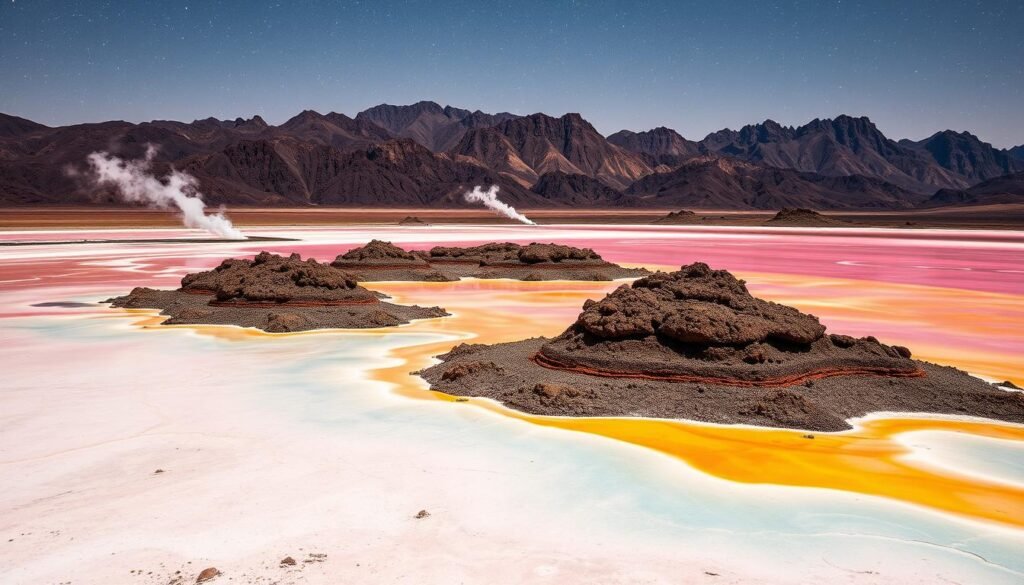
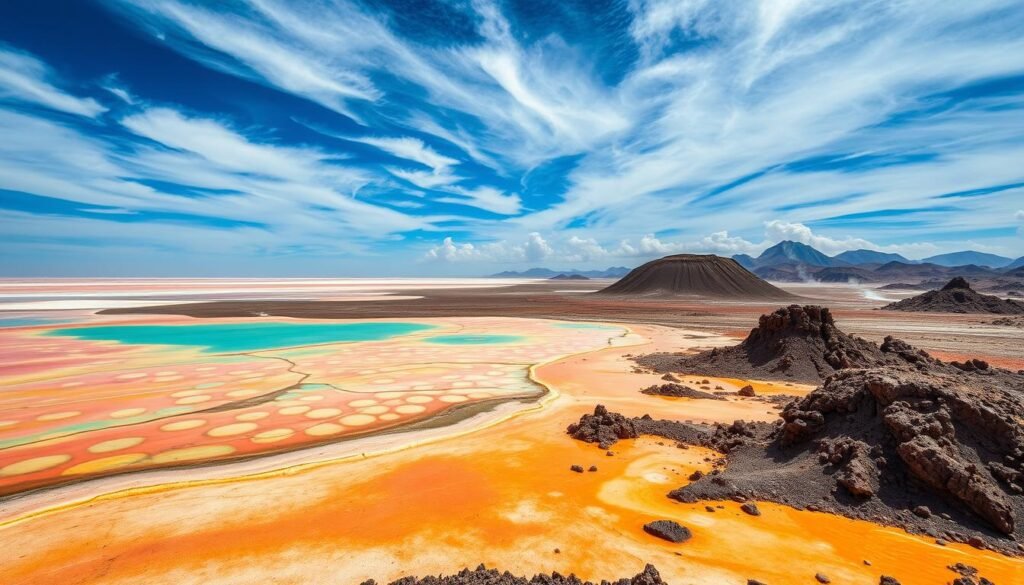
Visitors see its bubbling lava, colorful springs, and vast salt flats. These sights make it seem not of this world. They’re caused by the forces of nature.
The Danakil Depression is extremely hot and dry. Temperatures range from 95°F to 104°F. It’s more than 328 feet below sea level. Rainfall is rare, making it one of the driest places.
The best time for a visit is from September to May. This avoids the intense summer heat.
This area stretches about 125 by 31 miles, reaching into Djibouti and Eritrea. It’s the home of nearly two million Afar people. Their culture and way of life are fascinating for visitors.
Location and Geography of the Danakil Depression
The Danakil Depression sits in northeastern Ethiopia, mainly in the Afar region. It stretches into parts of Eritrea and Djibouti. It covers about 136,956 square kilometers. The area is known for being very low, about 125 meters below sea level. This is one of Earth’s lowest points, affecting the weather there.
At the junction of three tectonic plates, the land features striking geological sights. The Arabian, Nubian, and Somalian plates meet here. Their interactions shape the terrain, creating volcanoes, salt flats, and hot springs. The Danakil Depression gets really hot, with temperatures often hitting 48 degrees Celsius.
The place gets less than 25 mm of rain a year, making it one of the driest spots on Earth. Its low, dry condition keeps salt from old floods, enriching the land with minerals.
This area has lakes made by ancient lava. One is Lake Afrera, known for its thick salt crusts. Others include Lake Asale and Lake Giuletti, all below sea level. The harsh climate here is interesting for scientists to study.
| Geographical Feature | Details |
|---|---|
| Location | Northeastern Ethiopia, Afars region, southern Eritrea, northwestern Djibouti |
| Area | 136,956 sq km (52,879 sq mi) |
| Elevation | Approximately 125 meters below sea level |
| Average Temperature | 34.4°C (highest recorded: 49°C) |
| Annual Rainfall | Less than 25 mm (1 in) |
| Major Lakes | Lake Afrera, Lake Asale, Lake Giuletti |
Why the Danakil Depression is Known as the Hottest Place on Earth
The Danakil Depression is 350 feet below sea level in the Horn of Africa. It’s known as the hottest spot on Earth. Temperatures here can hit an incredible 118°F (48°C) on average. Sometimes, they even spike to 131°F (55°C) because of the heat from under the Earth.
This place is really hot because of where it is on the globe. It sits on three tectonic plates that are slowly splitting apart. This is part of the East African Rift System. The shifting plates mean there isn’t much seasonal cooling. So, it stays extremely hot all year.
It hardly ever rains in the Danakil Depression. This makes the ground dry and cracked. But you’ll also see bright-colored mineral deposits and big areas of salt. There are even acidic pools with a pH as low as 0.2. This is one of the highest acid levels found naturally. Some pools even have a pH of zero. They support life forms that can handle these tough conditions.
| Feature | Description |
|---|---|
| Elevation | 350 feet below sea level |
| Average Temperature | 118°F (48°C); extremes can reach 131°F (55°C) |
| Geological Setting | Located on three tectonic plates, part of the East African Rift System |
| Annual Rainfall | Very little, leading to extremely dry conditions |
| Acidic Pools | Average pH of 0.2, with some at pH zero |
| Area Size | Approximately 124 by 31 miles |

Understanding the Formation of the Danakil Depression
The Danakil Depression’s creation is driven by the movement of tectonic plates. This area, within the Afar Triangle, sees three tectonic plates meet: African, Arabian, and Somali. These meet-ups lead to a unique geological setup. It’s known for its outstanding features and active hydrothermal events.
The Role of Tectonic Plates
Tectonic plates play a big role in the Danakil Depression. Their movement apart creates forces that form this deep area. This process is ongoing. It has made cool formations and given us lots of minerals.
Geological Characteristics of the Depression
The geology of Danakil is a mix of rock types. You’ll find sedimentary rocks, volcanic ones, and those laden with salt. The depression is known for:
- Salt flats that cover large areas.
- Bright sulfur pools that look like another planet.
- Active volcanoes, like Erta Ale, which has a famous lava lake.
This area is rich in minerals like potash, sulfur, magnesium, and halite. The variety of rocks and minerals shows how active the Earth’s processes are in Danakil.
| Element | Type | Significance |
|---|---|---|
| Salt Flats | Geological Feature | Rich in mineral deposits and unique ecosystems |
| Volcanic Activities (Erta Ale) | Active Volcano | One of the most active lava lakes globally |
| Sulfur Pools | Colorful Geothermal Feature | Visually stunning and indicative of ongoing hydrothermal processes |
| Tectonic Activity | Geological Process | Catalyzes the ongoing evolution of the depression landscape |
The Danakil Depression helps us understand Earth’s shaping forces. It’s a fascinating topic for anyone studying geology.
Customs and Culture of the Afar People
The Afar people live in the tough Danakil Depression. Their culture is shaped by this environment. About 3,350,000 Afars live mainly in Ethiopia, Djibouti, and Eritrea. Their afars culture has traditions and social structures that show their strong spirit.
Tribal Lifestyle and Livelihood
Afar communities follow a tribal lifestyle of moving with their animals. This nomadic life helps them survive in their harsh land. They depend on their livestock for food and trade. Women are important, taking care of animals and milking them. Elders make sure traditions keep going, teaching the young.
Salt Mining and Its Importance
Salt mining is crucial for the Afar. They work the huge salt flats of the Danakil Depression. The salt goes to markets, especially Mekele, on camel caravans. This isn’t just business; it reflects the Afar afars culture of working together.
Learning about their pastoral and salt mining traditions shows the Afar’s depth. Visiting their land teaches about their way of life and resilience. For more on their culture, check out the Afar culture and lifestyle.
| Region | Population |
|---|---|
| Ethiopia | 2,700,000 |
| Djibouti | 342,000 |
| Eritrea | 304,000 |
| Total Global Population | 3,350,000 |
Exploring Dallol Crater: The Colorful Acid Springs
The Dallol Crater is a showcase of nature’s vibrant colors in the Danakil Depression. Its acid springs glow with colors because of geothermal heat. Bright greens, yellows, and reds mix together, forming an alien landscape.
Unique Geothermal Features
Dallol isn’t just a volcano; it’s a geothermal wonder. Groundwater meets magma here, creating colorful hot springs. Visitors marvel at the changing landscape filled with new springs and salt formations.
The Visual Spectacle of Dallol
The mix of vivid colors and strange formations gives a unique sensory experience. Visitors spend three to four days exploring Dallol Crater. It’s important to be careful as the ground can change anytime.
Studying extreme microbes here shows how life can adapt. Dallol Crater’s geothermal activity helps scientists understand more than just this area. It opens doors to wider scientific discoveries.
| Key Characteristics | Description |
|---|---|
| Location | Located in the Danakil Depression, Ethiopia |
| Elevation | 60 meters above the salt plain; 48 meters below sea level |
| Acidity | Notable for pH levels as low as 0.2 |
| Scientific Interest | Home to extremophile microbes and ongoing geological study |
| Safety Considerations | Unstable terrain requires robust footwear and experienced guides |
Learn more about how depressions can impact the environment
The Erta Ale Volcano: A Lava Lake Adventure
The Erta Ale volcano is a showcase of nature’s raw power. It draws adventure lovers from everywhere. Known for its large lava lake, it offers incredible views from the crater’s edge. A visit here is unlike any other. You can go night trekking to see the lava glow under the stars.
Visiting the Crater Rim
The journey to Erta Ale is thrilling. The trek is about 10 kilometers each way, taking 3 to 4 hours. It’s a gentle climb, but the heat can be tough for some. Guides and armed guards lead the way, ensuring safety while you enjoy stunning scenery. Rising 613 meters from the Danakil Depression, the volcano’s beauty and recent activity in January 2017, like a new pit crater and lava lake, are mesmerizing.
Night Trekking and Lava Viewing
Many like to trek at night for cooler weather and to see the amazing lava lake lit up. The top has temperatures around 25°C, making night hikes appealing. Starting in the evening is best to see the lava’s bright glow against the dark sky. This creates a breathtaking visual. Seeing the lava lake’s glow while feeling the extreme Danakil environment is unforgettable.
Discovering Lake Karum in the Danakil Depression
Lake Karum is in Ethiopia’s Danakil Depression. It’s one of the world’s saltiest lakes. Its wide, shiny surface attracts many visitors. The lake is fed by mineral-rich hot springs, making a unique and beautiful ecosystem.
Salt Lakes and Their Formation
Lake Karum formed due to the area’s geology and climate. It comes from water evaporating in the hot, dry air. The lake sits 125 meters below sea level. Temperatures can soar above 104°F. These conditions help form not just Karum but other salt lakes too. The Afar people have mined the Karum Salt Lake for centuries.
Activities on the Saline Waters
Visitors love the salty Lake Karum for many reasons. You can float in the water easily or take photos of the amazing sunsets. Getting there takes 1 to 2 hours from the nearest town. Local guides help tourists explore. They charge between $50 and $100 a day.
To visit, you should be well-prepared. Bring water, snacks, sunscreen, and a first aid kit. The area is remote with few services. Try to go in the cooler parts of the day. Morning or late afternoon is best to avoid the heat. Places nearby like the Danakil Salt Lake, Catherine Volcano, and Black Water Spring are worth seeing too. For more info, check out this link.
The Historical Significance of the Danakil Region
The Danakil Depression is stunning and full of history. It’s in Northern Ethiopia and famous for its fossils. Among these, “Lucy,” one of the oldest human ancestors, stands out.
Found in 1974, Lucy and other discoveries are key to understanding human history. They offer deep insights into our evolution. This makes the Danakil region crucial for archaeologists and historians.
Fossil Discoveries: The Lucy Connection
Fossils found here tell us more than just about Lucy. They help us know about life long ago. Scientists find early hominins and how they lived in tough places here.
This search for knowledge keeps the Danakil interesting for researchers. It’s all about connecting our past to understand humanity better.
Discoveries Relating to Extremophile Life
Extremophiles in the Danakil Depression show how tough life can be. These microbes live in very harsh conditions. Studies of them help us think about life on planets like Mars.
Their survival tactics are fascinating. Such studies could lead to big discoveries in space science. The Danakil’s mix of geology and biology connects our past to future discoveries.