Did you know the 1920s brought huge growth to the U.S. economy? The nation’s wealth doubled, earning it the name “Roaring Twenties.” But this boom led to the Great Depression, a tough economic downturn. This period showed both the weaknesses of financial systems and society’s strength. We’ll dive into stories and key facts about how this crisis changed American culture and policies.
Key Takeaways
- The 1920s saw explosive economic growth in the U.S., laying the groundwork for the Great Depression.
- The stock market crash of 1929 resulted in staggering losses and increased unemployment rates.
- The Dust Bowl caused massive migrations as drought devastated farming communities in the Southern Plains.
- FDR’s New Deal programs established crucial support systems and initiatives, providing millions with jobs and relief.
- The Great Depression revealed disparities in employment opportunities, particularly affecting women and African Americans.
The Roots of the Great Depression
The 1920s was a booming time, marked by significant growth and excitement in buying. Wealth in the United States doubled, fueling a rise in stock market investments and consumer buying. This optimism led many to invest in stocks, often overlooking the risks involved.
As companies grew and paychecks got bigger, optimism soared. This made it a prime time for investments.
Economic Boom of the 1920s
The 1920s prosperity seemed to know no bounds. Everything from cars to home appliances became must-haves. With the stock market booming, more people invested their money. But trouble was brewing. High stock prices didn’t match the real economy, hinting at future problems. Understanding these dynamics reveals the complex roots of the Great.
Stock Market Speculation and Irresponsibility
As stock market speculation grew, so did risky investments. The Federal Reserve’s cautious policies allowed only slight increases in money supply. This led to more careless investments. By decade’s end, it was clear: economic weak spots were setting the stage for the Great Depression.
Stock Market Crash of 1929
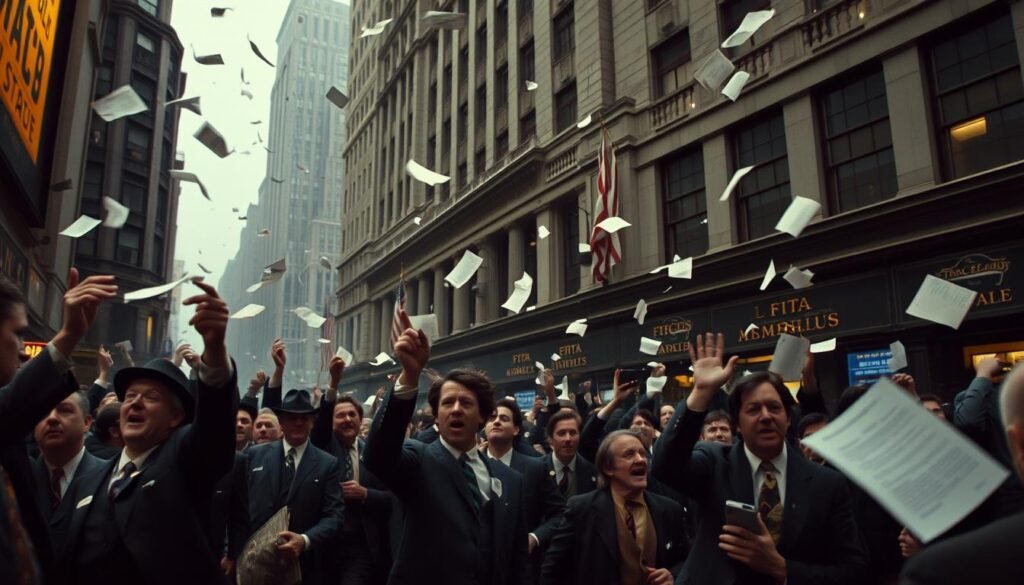
The stock market crash of 1929 was a key moment in U.S. history, causing long-lasting effects. It started on October 24, known as Black Thursday. That day, a wave of panic hit Wall Street, causing many investors to sell their shares quickly. This led to a record number of trades, showing that a big crisis was coming.
Black Thursday and Black Tuesday
Black Thursday saw about 12,894,650 shares traded, starting a big fall. The crisis hit its peak on Black Tuesday, a week later. That day, around 16,410,030 shares were traded, causing stock prices to plummet. The Dow Jones Industrial Average fell by nearly 13 percent on Black Monday, showing the scale of the crisis.
The Immediate Aftermath on Investors
Investors quickly lost billions of dollars. By mid-November 1929, the Dow had lost about half its value, showing the market’s turmoil. Unemployment increased as businesses failed and people bought less. This pushed many Americans into hard times. The crash changed the American economy, leading to deep recessions and making the Great Depression worse.
| Date | Event | Trading Volume | Dramatic Market Change |
|---|---|---|---|
| October 24, 1929 | Black Thursday | 12,894,650 shares | Initial panic selling |
| October 28, 1929 | Black Monday | Market dropped 13% | |
| October 29, 1929 | Black Tuesday | 16,410,030 shares | Most devastating loss in history |
Hoover Administration’s Response
The Hoover administration tackled the Great Depression with many steps. Yet, people were largely unhappy with its efforts. President Herbert Hoover tried to stabilize the economy with several actions. Sadly, these did little to fix high unemployment and failing businesses. Despite Hoover’s ambitious moves, they didn’t lessen the hard times faced by many Americans.
Ineffectiveness of Proactive Measures
In November 1929, Hoover asked business chiefs to keep wages steady despite economic woes. However, joblessness spiked. To boost jobs, industries planned to spend $1.8 billion on building and repair in 1930. Hoover also pushed for a $160 million tax cut and increased public project spending. Still, these actions fell short as the Depression worsened.
Public Perception and Terminology: “Hoovervilles” and “Hoover Stew”
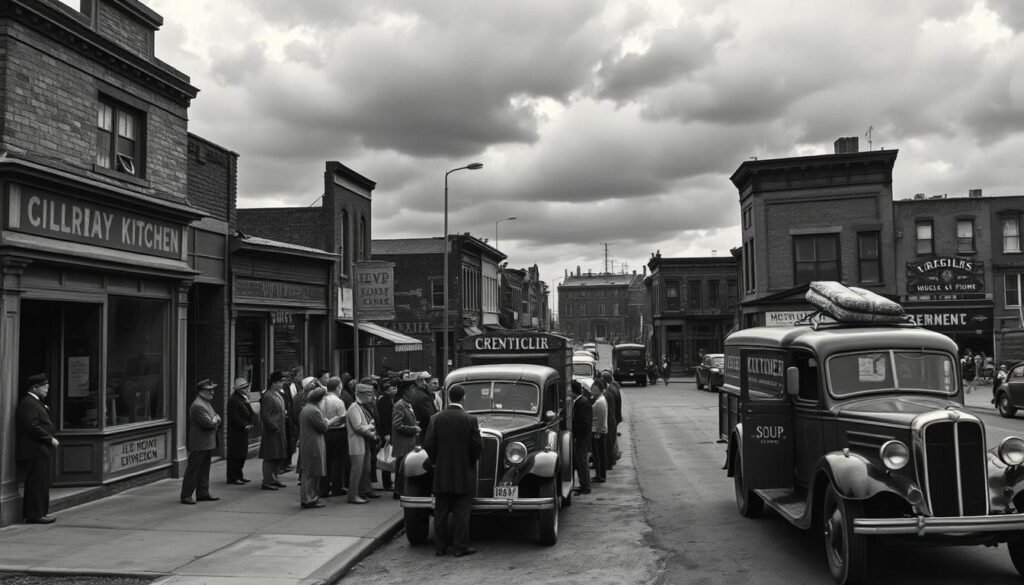
Public frustration with worsening conditions coined new phrases. “Hoovervilles” became the name for shanty towns where homeless people lived. The rise of soup kitchens saw the birth of “Hoover Stew,” a symbol of the meager meals offered. These terms reflected deep dissatisfaction with Hoover’s failure to combat poverty and social unrest.
The Dust Bowl Era
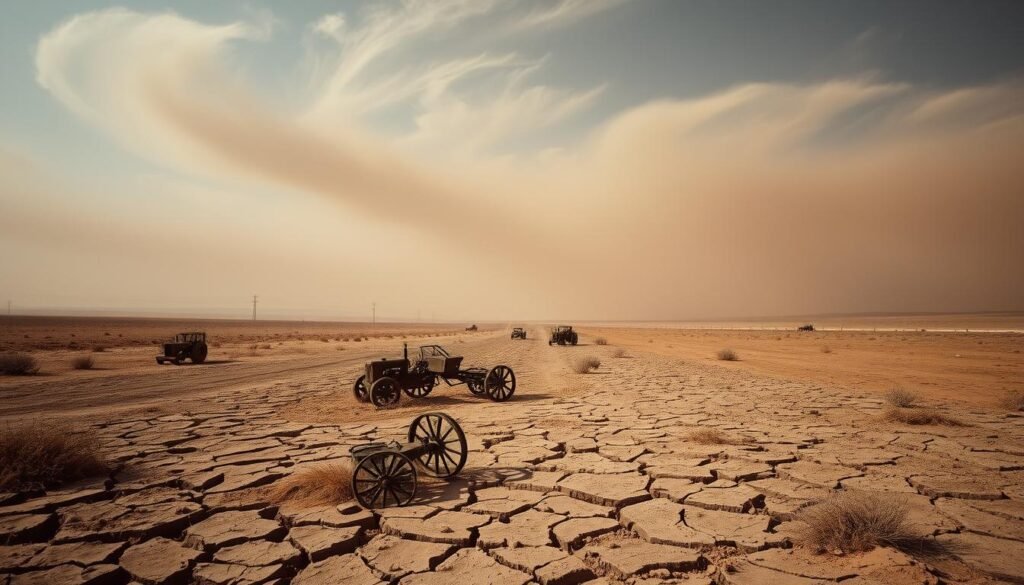
The Dust Bowl era was a critical time in American history. It highlighted the tough environmental and economic issues of the 1930s. This period saw extreme drought and farming methods that harmed the land. These problems led to a huge farm crisis.
The dust storms ruined the land and made many people move across the country. It was a tough time for everyone involved.
Causes and Consequences of Dust Storms
The Dust Bowl was caused by nature and people. Overusing the land for farming and grazing made the soil weak. The winters of 1934 and 1936 were very cold. The summer of 1936 was incredibly dry. About 35 million acres of farmland were lost, hitting communities hard.
Dust storms were so big, they reached places thousands of miles away. This showed how huge the problem was.
Impact on Migration Patterns in America
The Dust Bowl caused the biggest migration in U.S. history. Around 2.5 million people left their homes. Oklahoma lost about 440,000 of its people. Many went to California, hoping for a better life.
From 1935 to 1940, about 250,000 people from Oklahoma moved to the West Coast. This movement changed the country’s population patterns. People were searching for hope and a new start.
Fun Facts About The Great Depression
The Great Depression lasted from 1929 to 1939. It was a hard time but showed the strong spirit of Americans. People found ways to cope and even thrive during these tough years.
Creative Escapism and Entertainment: Dance Marathons
Dance marathons were big during this time. Folks danced for hours, aiming to win prizes. But it wasn’t just about competing. These events provided food, shelter, and friendship, helping many fight off gloom together.
Innovative Pastimes: Monopoly and Other Games
With money tight, families got creative for fun. Monopoly let people dream of wealth while stuck in poverty. Games like this offered cheap thrills and a break from daily woes. They’re a bright spot in Great Depression history.
The Boom of Hollywood: Iconic Films of the Era
Even with tough times, Hollywood flourished. Classics like “The Wizard of Oz” brought joy and wonder. These movies offered an escape, pulling folks into fantastical worlds. They were a beacon of hope when it was needed most.
| Entertainment Type | Description | Notable Examples |
|---|---|---|
| Dance Marathons | Competitive dance events that provided food and shelter | Public marathons held across cities |
| Board Games | Family-friendly games that provided escapism | Monopoly, Life, and Clue |
| Hollywood Films | Blockbuster movies that offered distraction and fantasy | The Wizard of Oz, Gone with the Wind |
This period wasn’t just about hardship. It was also full of creativity and strength. These facts highlight the rich culture that emerged.
Interested in more about how society deals with depression today? Visit this site for current insights and challenges.
New Deal Programs Instigated by FDR
President Franklin D. Roosevelt’s New Deal was a big change for the U.S. government during the Great Depression. With many people out of work, help was urgently needed. The New Deal created various programs to fix the economy and help the country recover.
Major Initiatives and Agencies Established
The Works Progress Administration (WPA) was a major part of the New Deal. It helped about 8.5 million people get jobs. They worked on big projects like building roads, schools, and bridges. The Civilian Conservation Corps (CCC) also offered jobs. These jobs focused on protecting the environment and maintaining national parks.
Other important agencies were the National Recovery Administration (NRA) and the Securities and Exchange Commission (SEC). The NRA worked on setting industry standards. The SEC helped keep the financial market stable and protected investors.
Impact on Employment Rates and Support Systems
The New Deal changed how the U.S. supported people without jobs. The Social Security Act of 1935 set up pensions. This helped the elderly and unemployed people a lot. Also, the Federal Deposit Insurance Corporation (FDIC) made people trust banks again by insuring their deposits.
By 1937, about 8 million workers had joined unions. This made work conditions better. Despite some success, the true value of these policies is still debated by historians. They changed the political scene and affected future elections, showing a big shift in American society. For more details, click here.
Unemployment Rates in the 1930s
The Great Depression was a tough time in American history. During its worst, more than 25% had no jobs in the 1930s. This high number showed the big problems people faced as work disappeared quickly. Many families had a hard time, dealing with not having enough food, losing their homes, and feeling like there was no hope.
Statistics and Personal Stories of Employment Struggles
The numbers really show how bad the Great Depression was. By 1932, about one in four workers in the U.S. had no job. Veterans struggled a lot during this time, too. About 20,000 veterans from World War I, called the Bonus Army, marched to Washington, D.C., in June 1932. They wanted the money they were promised for serving. But they were met with resistance, showing the tough times many were going through.
In cities everywhere, people were so desperate that there were hunger marches and even riots.
Long-Term Economic Consequences for Families
The Great Depression really changed families and how society worked. With banks and businesses failing, many lost everything they had saved. People made makeshift homes in places called “Hoovervilles” because there were so many without a place to live. Even with enough food in the country, hunger and not having enough to eat were common problems. This tough decade affected how families and communities worked together for a long time.
| Year | Unemployment Rate | Major Events |
|---|---|---|
| 1929 | 3.2% | Stock Market Crash |
| 1930 | 8.7% | Ongoing Bank Failures |
| 1932 | 25% | Bonus Army March |
| 1933 | 24.9% | First New Deal Programs |
| 1939 | 17% | Economic Recovery Begins |
The Role of African Americans and Women
The Great Depression was a tough time that made job problems worse for groups like African Americans and women. For African Americans, it was harder to find jobs. Their unemployment was much higher compared to white workers. In 1932, about 50 percent of African Americans had no jobs. In cities like Atlanta, the situation was even worse with nearly 70 percent jobless by 1934.
Disparities in Employment Opportunities
In cities, the job gap was clear. While 25 percent of white workers had no jobs in Northern cities in 1932, over 50 percent of African Americans were unemployed in places like Chicago. This was even higher in cities like Pittsburgh, Philadelphia, and Detroit. Despite these hard times, over 70 percent of African Americans supported Roosevelt in the 1936 election. They hoped his New Deal programs would help. However, these programs often didn’t treat everyone equally. They led to separate camps and many inequalities.
Advancements in Female Employment and Advocacy
The number of working women grew by 24% from 1930 to 1940. This increase brought the total to 13 million. Women started doing jobs usually held by men, even though they got paid less. Discrimination was still a big problem. More than 25% of the National Recovery Administration’s wage codes set lower wages for women. Married women had a harder time finding jobs than single women because of social stigmas. Yet, the fight for women’s rights grew stronger. Women became more visible in public service and found meaningful work.
To learn more about the experiences of African Americans during this time, check out this link. It also covers important political changes.
Conclusion
The Great Depression was a key event in U.S. history. It showed how economic crises can deeply change society. From 1929 to the start of World War II, this tough time taught us about economic strength, helping each other, and the key role of government during a crisis. Unemployment reached about 25% in 1933, and factories produced much less. This showed the big impact of the depression on American lives and the economy.
The era led to major government reforms like social security and new financial rules. These changes aimed to fix serious problems and keep citizens safe. As Stanford historian David M. Kennedy points out, the Great Depression highlighted the critical role of government in helping people through tough economic times. Looking at the Great Depression’s effects, we see its lessons still matter in today’s economic talks.
Looking back at the Great Depression, we learn the value of being ready for financial downturns. This difficult time influenced how we think about economic safety nets now. By remembering the past, we can better deal with today’s and tomorrow’s economic challenges. It shows how important a proactive and caring government is when people are in need.