About 1 in 3 adults in the United States has cardiovascular disease. This fact shows why learning about heart health is critical. One key area is J point depression, found in an electrocardiogram (ECG). This can highlight serious heart issues.
The J point is at the heart’s QRS complex moving into the ST segment on an ECG. It’s pivotal for assessing a person’s heart health. Knowing about J point depression can reveal risks of arrhythmias and other heart troubles.
Key Takeaways
- J point depression is crucial for assessing heart health risks.
- It indicates potential arrhythmias and other cardiac conditions.
- The J point represents the transition from the QRS complex to the ST segment on an ECG.
- Understanding J point changes can aid in the prevention of sudden cardiac events.
- Regular ECG screenings can help identify J point abnormalities early.
What is the J Point in Electrocardiograms?
The J point is crucial in reading electrocardiograms (ECGs). It shows where the QRS complex ends and the ST segment begins. This spot is key as it marks a shift in the heart’s electrical pattern, from depolarization to repolarization.
Changes in the J point can either be an elevation or a depression. These variations are important. J point elevation often goes hand in hand with ST segment elevation. Meanwhile, J point depression pairs with ST segment depression. Spotting these differences is critical for finding heart issues like ischemia or other electrical problems.
Sometimes, the J point might show notches or become slurred. This can point to unusual electrical activity in the heart. These signs are important and may hint at conditions like early repolarization or the Brugada syndrome. Both are related to abnormal J point activities.
Keeping an eye on the J point is key for diagnosing heart problems tied to the ST segment. Understanding its function helps in grasping heart health better. Thus, it plays a big role in ECG interpretations.
| Aspect | Description |
|---|---|
| Location | Between the end of the QRS complex and the start of the ST segment |
| Significance | Indicates transition from depolarization to repolarization |
| Elevation Effects | Can lead to ST segment elevation |
| Depression Effects | Can result in ST segment depression |
| Indicators of Abnormality | Notching and slurring |
| Associated Conditions | Ischemia, early repolarization, Brugada syndrome |
The Significance of J Point Depression
J point depression is key in predicting heart health. It shows if someone may have heart issues that need more attention. When seen on an electrocardiogram (ECG), it suggests a risk of heart injury or blockage. This finding is linked to irregular heartbeats and overall heart risk.
Research shows that early repolarization (ER) is found in 13% of people. Most of them, over 75%, are men. A higher J point elevation is seen in these cases. This shows men are mainly affected, pointing to the need for special attention in this group.
The link between J point depression and heart issues is clear. People with J waves have a higher chance of sudden heart death. The danger increases from three to 30 per 100,000 based on the ECG changes. This fact highlights the importance of early ECG checks.
Genetic research has shed light on J point depression. It is linked to changes in heart channel genes. People with unknown heart rhythm problems often have J waves. This differs greatly from healthy people. It calls for more study into how genes affect heart rhythm issues.
Recent research found that certain ECG signs predict worse outcomes. Patients with these signs faced higher death rates and more heart disease risks in the hospital. These insights stress the need for careful ECG watching to judge heart health.
Knowing J point depression’s impact helps doctors catch early heart risks. Early action can better heart health outcomes for those at risk. It offers hope for preventing serious heart problems.
Understanding J Point Depression
J point depression is key in reading ECGs. It shows a drop at a specific point in the heart’s electrical cycle. This change signals that something might not be right with how the heart resets its beat. It’s crucial to know about this, as it could show up in healthy people as well as those with heart problems.
If j point depression goes over 1mm, it might mean a heart issue, like blocked arteries or a heart attack. Knowing these signs helps doctors act fast to help the patient. Sometimes this problem happens during exercise or because of certain medicines.
Doctors need to carefully read ECGs to catch j point depression. Good ECG interpretation helps them find issues early. Then, they can pick the best way to treat the patient, preventing more serious problems.
| Condition | ST Segment Type | Clinical Implications |
|---|---|---|
| Exercise-induced | Depression | Potential ischemia |
| Myocardial Ischemia | Depression | Risk of heart attack |
| Non-ST Elevation MI | Depression | Indicator of ongoing cardiac issues |
| ST Elevation MI | Elevation | Correlates with significant heart damage |
| Hypokalemia | Depression | Electrolyte imbalance effects |
| Digoxin Use | Depression | Medication influence on heart rhythm |
| Left Ventricular Hypertrophy | Depression | Sign of heart muscle thickening |
| Left Bundle Branch Block | Depression | Conduction delay indicators |
Understanding j point depression helps doctors care for their patients better. They can make more accurate heart health assessments. This leads to improved care plans and treatment choices.
How J Point Depression Affects Heart Health
It’s key to grasp how j point depression affects the heart. This change in an electrocardiogram signals possible heart problems. Such issues can lead to arrhythmias and affect heart function deeply.
Research points out different J wave syndromes and their risks. For example, Brugada Syndrome shows how critical j point depression is. It’s a sign and a marker for serious conditions. These syndromes show how genes play a role in heart health.
Repolarization issues can have varied effects. Studies link J point changes to sudden cardiac death risks. Checking J wave amplitude and medicine responses help gauge heart risks. Certain drugs can alter these markers, adding to patient care complexity.
The changes in early heart repolarization need constant watch. This highlights the need for ongoing research on j point depression. Understanding these patterns is crucial for protecting heart health in the long term.

Common Causes of J Point Depression
Knowing why j point depression happens is key to spotting heart problems. Myocardial ischemia is a main reason. It means the heart’s muscle doesn’t get enough blood and oxygen. This issue shows up on an ECG as j point depression, often in certain parts of the heart.
Left ventricular hypertrophy (LVH) is another cause. It’s when the heart works too hard for too long. This makes the heart’s muscle thick. LVH can change the way j waves and the ST segment look on an ECG. Early repolarization is usually not a problem. But, it can make it hard to read ECGs right. This issue could mean a higher risk of sudden heart stoppage, especially seen in specific ECG leads.
Pericarditis is when the heart’s outer layer gets swollen. It can make ECGs look like j point depression. This makes it hard to tell what’s actually wrong with the heart. Knowing the difference between these conditions and serious heart issues is crucial.
The reasons behind j point depression are complicated. It’s about how the heart’s muscle reacts to stress. Figuring out the exact problem needs a careful look at the patient’s health history and ECG. Learning about early repolarization syndrome is important too. It can appear in ECGs in certain situations.
| Cause | Description | Related ECG Findings |
|---|---|---|
| Myocardial Ischemia | Reduced blood flow to heart muscles. | J point depression in inferior and anterolateral leads. |
| Left Ventricular Hypertrophy (LVH) | Heart muscle thickening due to pressure overload. | Prominent J waves and ST segment changes. |
| Pericarditis | Inflammation of the pericardial sac. | Similar patterns to j point depression. |
Clinical Manifestations of J Point Depression
J point depression symptoms can differ a lot from one person to another. This affects symptoms and how doctors diagnose it. Some people might have slight palpitations. Others could face serious heart rhythm problems that need quick help. Knowing about j point depression quickly is very important, especially in emergencies. Fast action can save lives.
Spotting j point depression can be hard because its signs are often not obvious. People might feel:
- Palpitations – feeling your heart beat too fast or unevenly.
- Dizziness – getting lightheaded or almost fainting when moving.
- Chest pain – which can happen during heart rhythm issues.
- Shortness of breath – mainly if you’re doing something strenuous.
- Collapsing or fainting – this is more common in serious cases.
Finding j point depression during a check-up might suggest more serious health issues. Doctors use ECGs to look for specific signs. This makes knowing what to look for very important. Sometimes, in urgent situations, doctors might say:
“Spotting j point depression can change how we care for patients with heart rhythm problems. It shows why we need to watch them closely and act fast.”
Here’s a table that shows different health issues linked to j point depression and what they mean:
| Condition | Clinical Manifestation | Implications |
|---|---|---|
| Early Repolarization | ST segment elevation seen on ECG | It might be harmless but could also mean a higher risk of sudden heart death |
| Brugada Syndrome | Type 1, type 2, or type 3 ECG patterns | Can cause fainting or deadly heart rhythms |
| Hypokalemia | Changes in T-wave and ST segment | Leads to heart rhythms problems that need urgent help |
| ST Elevation Myocardial Infarction (STEMI) | ST segment changes with chest pain | Very dangerous, needs fast medical action |
Understanding j point depression helps in handling it properly. It’s key for medical staff to watch out for heart rhythm issues it might cause.
J Point Elevation vs. J Point Depression
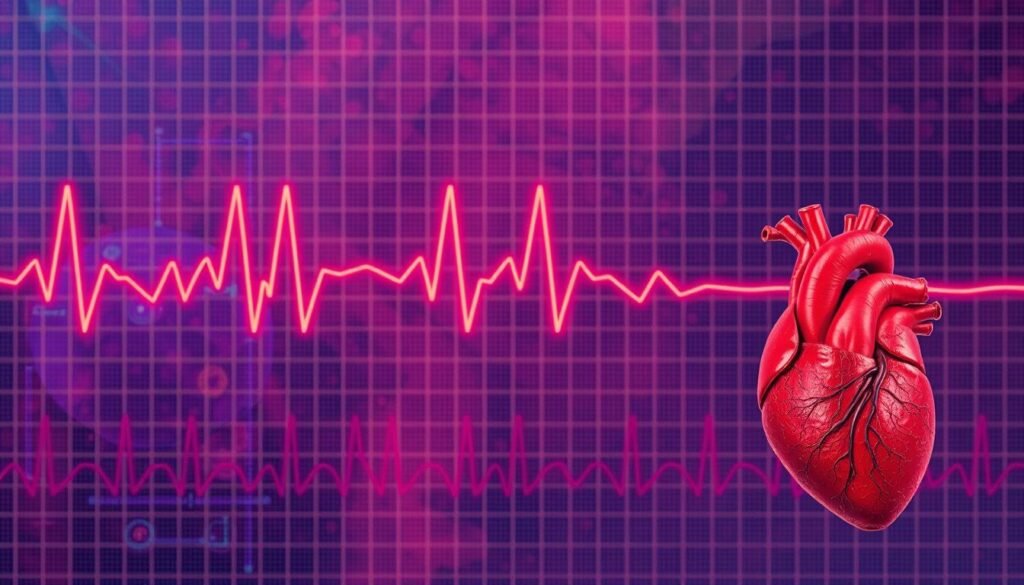
Learning about j point elevation and depression is key for heart health. These elements show up in ECG tests. They help doctors decide on care methods.
J point elevation is seen in conditions like early repolarization or heart attacks. There’s a new focus on a 2mm elevation in certain ECG leads. This is based on Marriott’s criteria. The American College of Emergency Physicians also has guidelines to identify heart attacks using ECG. These rules show how vital the clinical setting is when reading ECG results.
On the other hand, j point depression points to myocardial ischemia if it’s 0.5 mm or more. It’s especially telling if the depression is horizontal or slopes down. Things like exercise or certain medications can cause it.
J point issues can happen together or by themselves. This impacts how doctors view ECG changes. Knowing about J point conditions is crucial. It helps doctors understand what these ECG patterns mean for their patients.
Risk Factors Associated with J Point Depression
J point depression is a big sign of possible heart disease. Many risk factors make it more likely, showing why it’s key to know these risks for better health.
- Age: Older people often have more heart disease. Studies show that those over 50 might see j point depression more than early repolarization.
- Gender: Young men especially might have ECG patterns that look like j point depression. This can make it hard to figure out what’s really going on.
- Existing Cardiovascular Disease: If you’ve had heart problems before, you’re at higher risk for j point depression. This can lead to even more health problems.
- Family History: Your genes matter a lot here. If heart issues run in your family, you could be more likely to get j point depression.
- Fitness Level: Athletes show different heart patterns. Even though they’re in good shape, they can still be at risk for j point depression.
Research has found that 10-15% of people in the emergency room for chest pain might have j point depression. It’s really tricky to figure out, especially in those over 70. They need careful checks to make sure nothing else is wrong.
It’s super important to know who’s more likely to get heart disease. People with heart issues in their family might feel j point depression more. They need specific plans to lower their health risks.
Diagnostic Techniques for J Point Depression
Finding j point depression needs advanced tools, mainly electrocardiography. These methods catch slight heart changes, key for checking heart health.
- Standard Electrocardiography (ECG): A key process that displays the heart’s electrical beats. It shows ST segment changes linked to j point depression.
- Holter Monitoring: This records heart rhythms non-stop, over a day or more. It’s crucial for spotting brief j point depression that standard ECGs might miss.
- Signal-Averaged ECG: A more intricate technique that spots minor heart rhythm shifts. It offers detailed insights into j point depression.
Each technique helps fully grasp j point depression and its impact on the heart. Reviewing the ST segment is vital for spotting myocardial ischemia. Noticing certain patterns, like upsloping or flat segments, tells doctors of potential heart risks.
Simply put, these tools are key for quick and precise heart condition data. Prompt spotting and early action greatly help patient care and start treatment for heart diseases sooner.
| Technique | Description | Use in Diagnosis |
|---|---|---|
| Standard ECG | First-line method to assess heart activity | Identifies j point depression and ST segment changes |
| Holter Monitoring | Continuous monitoring system over an extended period | Detects transient events of j point depression |
| Signal-Averaged ECG | Enhanced method for detailed heart rhythm analysis | Identifies subtle electrophysiological alterations |
Management and Treatment Options
Managing j point depression is key for better heart health. Since causes vary, treatments do too. A mix of lifestyle changes and medical help is often needed.
Lifestyle tweaks like a better diet, exercise, and handling stress are first steps. These can boost heart health and ease j point depression symptoms. Doctors should give advice that fits the patient’s specific situation.
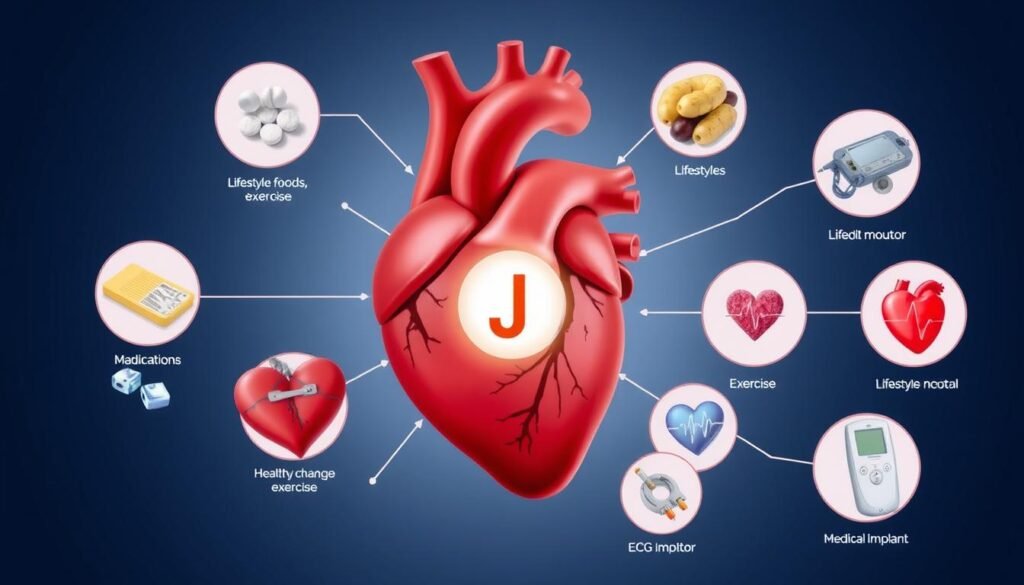
If lifestyle changes don’t do enough, medicine might be needed. Drugs that target depression and heart risk can help a lot. Since depression is common in heart disease patients, treatments must tackle both mental and physical issues. Effective treatment is crucial.
Health experts use tools to see if treatments work. Regular checks help fine-tune therapy, making sure patients get top care. Sometimes, surgery might be the only way. This is for those who don’t get better with usual treatments, showing why early help is vital.
Family involvement is important too. Their support helps emotionally and can push patients to follow their health plans. This can greatly improve recovery from j point depression.
To sum up, tackling j point depression needs a complete view. Plans that mix meds with behavior therapy are key. This approach doesn’t just manage symptoms. It can also lower death rates linked to heart issues.
Preventive Measures for Heart Health
Maintaining a healthy heart involves several steps. These steps are key to lower the risk of heart issues and improve well-being.
A heart-healthy lifestyle is crucial for long-term heart health. It includes:
- Regular Exercise: Working out regularly helps prevent coronary heart disease. Even light exercise helps against cardiovascular problems.
- Healthy Diet: Eating lots of fruits, veggies, grains, and lean meats supports heart health. It’s best to avoid too much sugar and bad fats.
- Stress Management: Managing stress through mindfulness or hobbies helps keep the heart healthy. It helps lower risks linked to j point depression.
Doctors should push for regular ECG checks, especially for those at higher risk. This includes veterans and people with mental health issues. Catching problems early is key to stopping serious heart problems.
Raising awareness of how mental and heart health link is vital. Emotional health directly affects the heart. It is important for everyone to watch for signs of mental and heart issues.
Mixing mental health checks into general health reviews is a smart move. Teams of mental and heart health experts can offer better care. They help those facing both mental and heart health challenges.
To wrap up, a mix of lifestyle changes and early checks can greatly help heart health. Giving people the tools and knowledge they need leads to better health results.
Recent Research on J Point Depression
Recent studies have made big strides in understanding j point depression. They show us more about its health risks and effects on the heart. Ongoing research digs deeper into why it happens. This gives us new ideas on its impact on heart health.
A study with 2014 men in the middle of their lives found something interesting. 20% had a certain pattern in their heart tests during exercise. This group was 30% less likely to die from heart disease than others. It seems some heart patterns during exercise could protect us.
But, those with ST-depression faced more danger. Their risk of dying from heart disease was 1.45 times higher. This tells us that spotting j point depression is key. It hints at a higher chance of heart problems.
There’s been a mix of findings on ST-segment changes, especially about j point depression. Experts don’t always agree on what they see. This has led to calls for clear rules in research. There’s a push to accurately judge heart tests right after the J point.
Getting the details right helps doctors know who might face serious heart issues. More studies will keep untangling this complex health issue. They’ll highlight how crucial it is for our heart’s health.
| Study Group | Risk of CHD Death | Average Follow-Up Duration |
|---|---|---|
| Rapidly Upsloping ST-Segment | 30% decreased risk (HR 0.70) | 35 years |
| Normal ST-Segment | Baseline Risk | 35 years |
| ST-Depression Group | 1.45-fold increased risk (HR 1.45) | 35 years |
| Cardiovascular Disease Death Risk | Numerically lower in rapidly upsloping group (HR 0.82) | N/A |
Conclusion
The study of J point depression is key to heart health. Research shows it’s crucial for people with heart issues, especially after a sudden cardiac arrest. It’s been found more often in such individuals than in healthy folks.
This issue isn’t just for experts but is important for all in heart care. We need more studies to get better at diagnosing and treating these problems. This will help improve patient outcomes.
Understanding J point depression helps doctors and patients alike. With more knowledge, we can work on keeping hearts healthy and reducing heart-related risks. This is not an end but a start for further research and practice in this field.