Did you know the angle of depression is more than a textbook idea? It’s used in real life, like when a plane lands. The plane’s angle of depression from 2,714 feet up helps pilots land safely. This angle is key in many areas, including surveying and trigonometry.
It helps us figure out how high buildings are or how far away something is. Understanding the angle of depression helps with lots of number problems.
Key Takeaways
- The angle of depression represents the angle below the horizontal line when observing an object at a lower elevation.
- This concept is foundational in trigonometry, facilitating the calculation of heights and distances.
- Real-world applications include surveying, navigation, and various fields requiring accurate measurements.
- Understanding the relationship between angles and distances is critical for solving practical problems.
- The angle of depression demonstrates how mathematical concepts are intrinsic to everyday life.
Understanding the Angle of Depression
The angle of depression is key in trigonometry. It happens when someone looks down from a higher point. They spot an object below a straight line. This angle is not just crucial for school but is also used in engineering and flying.
To measure this angle, we use math and a formula: Tan θ = Opposite Side/Adjacent Side. The angle θ shows how points in space relate to each other. It tells us the angle between what we see straight ahead and where we are looking down.
The angle of elevation is the opposite of depression. It talks about where the thing we’re looking at is compared to us. This makes it easier to understand how things are placed.
We can use this knowledge in real situations. For example, figuring out a tower’s height or watching something from a plane. These math skills help us solve problems in many areas, not just in school.
Angle of Depression Definition
The angle of depression is defined by the angle between a horizontal line from your eyes and your line of sight going down to an object lower than you. It’s very important in engineering and navigation. It helps to measure distances and heights correctly.
Key Terminologies Related to Angle of Depression
Understanding the angle of depression means knowing some key terms. These are:
- Observer: This is who or what is looking at the object.
- Object: This is what’s being looked at, usually below the observer.
- Horizontal Line: A line level with the ground, used as a starting point for measuring angles down.
- Line of Sight: The direct line from the observer’s eyes to the object.
Significance in Trigonometry
The angle of depression is very important in trigonometry. It’s used in calculating distances or heights in right triangles. By using trigonometric ratios like sine, cosine, and tangent, you can find unknown distances or heights. This knowledge is really handy for solving real-world problems accurately.
How to Calculate the Angle of Depression
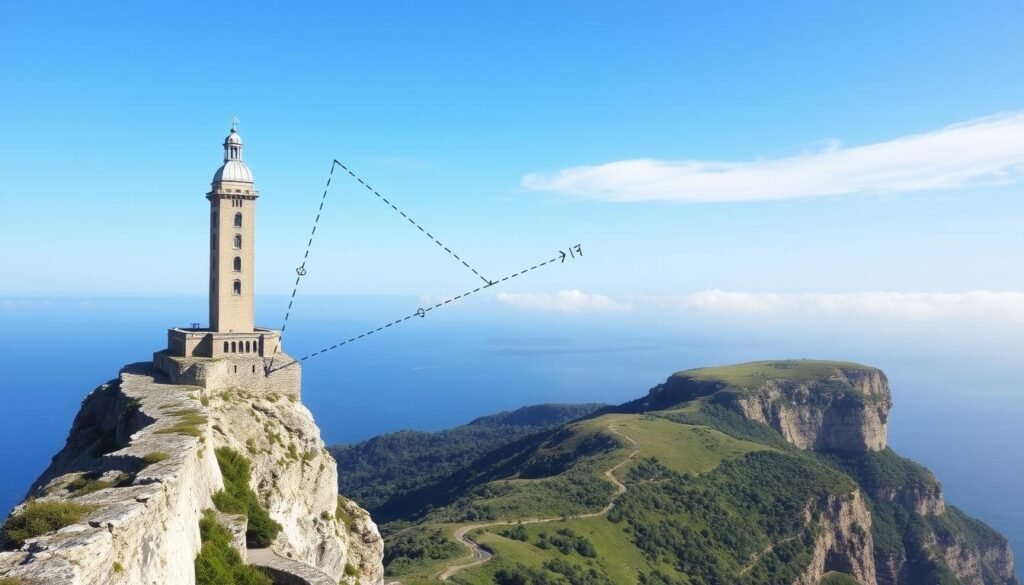
To calculate the angle of depression, you use trigonometric ratios. These ratios connect the sides of a right triangle formed by the observer, the observed object, and a horizontal line. Knowing how to do these calculations helps in many areas like architecture and navigation.
Using Trigonometric Ratios
The formula for the angle of depression is easy to express mathematically. It is:
- Tan θ = Opposite Side / Adjacent Side
- θ = tan⁻¹(Opposite Side / Adjacent Side)
For angle calculations, the opposite side means the vertical distance to the object. The adjacent side is the horizontal distance from the observer to the object. This method lets you find unknown measurements, like surveying land.
Real-life Calculation Examples
There are many real uses for the angle of depression. One example is measuring a building’s height from a distance. Here, knowing the angle lets an observer find the height using the tangent ratio:
| Distance from Object (b) | Height of Object (a) | Angle of Depression (α) | Calculated Height (h) |
|---|---|---|---|
| 50 ft | 30 ft | atan(30/50) = 32° | 30 ft |
| 100 ft | 60 ft | atan(60/100) = 31° | 60 ft |
Architects may use these calculations for structural integrity in buildings, bridges, and more. With surveying tools, they can measure angles more precisely, improving their projects.

Calculating the angle of depression is also crucial in navigation. Pilots, for instance, use these angles to plan safe landing paths in aviation.
Learning about depression angle calculation through trigonometric ratios and real-life examples boosts your analytical abilities in many fields.
Angle of Depression vs. Angle of Elevation
The angle of depression and the angle of elevation are key concepts in geometry. They differ in the observer’s line of sight. The first is when you look down, and the second when you look up. Both angles are handy for calculations.
Basic Differences Explained
In an angle comparison, these angles have similar principles but differ in two main ways:
- Direction: The angle of depression goes downward. The angle of elevation goes upward.
- Position: For depression, the observer stands above the object. For elevation, the observer is below it.
Applications in Real Life
These angles are used in many areas of life. They are vital in fields like:
- Architecture: They help architects design safe and beautiful buildings.
- Sports: Athletes use these angles to improve their game.
- Surveying: Surveyors use them to measure land accurately.
Understanding these angles involves using trigonometry. An angle of elevation might be 35 degrees from a cat to a tree top. Meanwhile, a depression angle might measure 68 degrees and 23 minutes for distance calculation. These examples show how important these angles are every day.
| Aspect | Angle of Depression | Angle of Elevation |
|---|---|---|
| Definition | Angle formed by the line of sight looking downwards | Angle formed by the line of sight looking upwards |
| Direction | Downward | Upward |
| Observer Position | Above the object | Below the object |
| Common Uses | Construction, navigation, surveying | Architecture, sports, physics |
By understanding these angles and their uses, we can apply geometry better in our lives. These concepts help us in various ways, from sports to architecture.
Applications of Angle of Depression in Various Fields
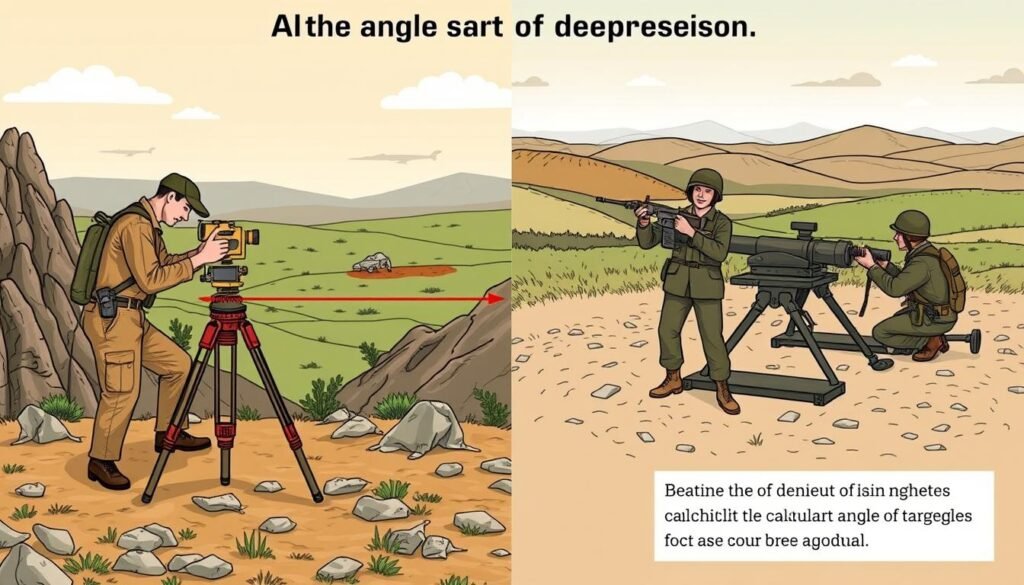
The angle of depression is widely used in many areas such as surveying and military operations. It is crucial for measuring landscapes and their features accurately. Professionals rely on it to get reliable data which helps them make informed decisions.
Surveying Techniques that Use Angles
Surveyors use the angle of depression to measure heights and differences in elevation. This method is key to setting land boundaries and drawing up detailed maps. Here’s why angle depression is beneficial in surveying:
- Determining Heights: It helps find out how tall structures or natural features are.
- Distance Measurements: This angle is used to figure out the space between two points.
- Precision Mapping: It allows for accurate positioning of various objects.
Projectile Motion and Artillery Firing Angles
In the military, knowing how to calculate artillery firing angles is crucial. The angle of depression helps with aiming projectiles precisely so they hit the target. The connection between this angle and artillery includes:
- Trajectory Calculation: It’s key for aiming with accuracy.
- Effective Range Assessment: The angle helps work out how far a projectile will go.
- Impact Prediction: By understanding angles, one can predict where a shot will land, which is vital for strategy.
| Field | Application | Benefits |
|---|---|---|
| Surveying | Elevation and distance measurement | Enhances accuracy in land mapping |
| Military | Artillery firing calculations | Improves targeting efficacy |
| Navigation | Determining position and altitude | Supports safe and efficient travel |
Examples of Angle of Depression Problems
Angle depression problems matter in many daily situations. They help us calculate heights and distances accurately. This is crucial in engineering, navigation, and even everyday tasks. We’ll look at two examples to show how to use angle depression.
Example 1: Calculating the Height of a Tower
An observer stands atop a 50-meter-high tower. They measure the angle of depression to the ground at 30 degrees. To figure out the distance to the point, they use a formula:
Angle of Depression = (1/tan)*(Opposite Side/Adjacent Side)
Through trigonometry, the horizontal distance is found. This helps accurately determine heights, a key aspect in understanding angle depression.
Example 2: Finding Distance Across a Lake
Consider a bird 150 meters high, with a 45-degree angle of depression towards a fish below. Using the principles we mentioned, we can calculate the distance between the bird and the fish. This example shows the practical use of angle depression and how it can help in real-life.
Knowing about angle depression helps in more than just math. It’s a valuable skill for figuring out structure heights and distances across areas. For more on tackling depression, check out this resource.
Common Pitfalls in Solving Angle of Depression Problems
Solving angles of depression problems can be tough. It’s crucial to understand the angles well to avoid mistakes. Often, people mix up angles of elevation and depression, which messes up their calculations.
Misunderstanding the Angles
Solving angle depression problems often gets tricky because of confusion. The angle of depression goes from a horizontal line down to an object. It’s different from the angle of elevation, which goes upward. Mixing these up can lead to wrong answers. Knowing how right triangles work is important because it affects how we use trigonometry.
Calculation Errors to Avoid
Making mistakes in calculations is common but avoidable. Mistakes often happen when:
- Choosing the wrong angle for finding distances or heights.
- Not properly considering the triangle’s shape, which leads to errors.
- Skipping drawing the problem, which helps understand angles and sides better.
To get better at these problems, practice sketching them and use the right trig functions. Check out geometry common core teaching notes for tips on avoiding these errors.
Angle of Depression in Everyday Life Situations
The angle of depression is a part of everyday activities. It helps people understand heights and distances easily. This concept is important when looking at buildings from above or from a hilltop. It plays a big role in how we see the world around us.
Practical Scenarios
Let’s look at common examples of the angle of depression. Picture observing a car from the top of a tower, or an electrician looking down from a pole. These situations show how this angle helps us guess distances and heights. They make the angle of depression a practical part of daily life.
For example, to find how far a car is from a tower’s base, we can use trigonometry. By using θ = tan-1(p/b), one can figure out the tower’s height. Doing these calculations improves math skills. It also helps us understand these concepts better in real situations.
Understanding Through Visuals
Using visuals can make the angle of depression clearer. Consider a pilot in a cockpit or someone looking into the Grand Canyon. These images turn abstract ideas into something we can grasp. Take an individual 1.5 meters above the floor working out an angle of depression of 21.8°. This shows how high points give us special views.
In another case, a ground crew member sees an Airbus A380 cockpit window 7.13 meters up. This situates both angles of depression and elevation at roughly 12.25°. Examples like this help us picture measurements. They also deepen our understanding of math in real life.
| Scenario | Measurement | Angle of Depression | Mathematical Expression |
|---|---|---|---|
| Tower Observation | Distance of Car from Base | Variable | tan-1(p/b) |
| View from a Cockpit | Height of Cockpit | 12.25° | Various Trigonometric Ratios |
| Grand Canyon Lookout | 1 Mile Distance | 45° | sin-1(p/h) |
Conclusion
The angle of depression is key in trigonometry. It’s the angle from your eye line down to an object below. It plays a huge role in many real-world situations. These include watching ships from lighthouses or figuring out how far you are while flying.
Learning to calculate this angle with trigonometry is a real game-changer. It helps people solve practical problems. For a pilot, it’s about planning a safe landing path. For an architect, it’s crucial when they design roofs at just the right slope.
This knowledge is essential not just in school but in many careers. It helps in engineering, designing buildings, and flying planes. With a good grip on angles, tackling real-world challenges becomes easier.
Understanding both angles of depression and elevation sets you up for success. It sharpens your problem-solving skills in various fields. For more on how to handle challenges, even in mental health, check out this resource.